The S Word by John Nichols
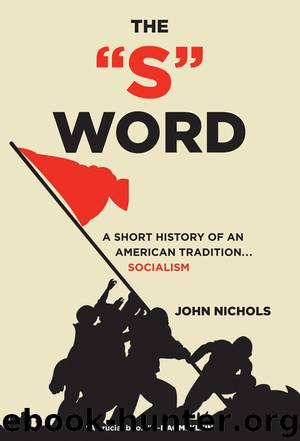
Author:John Nichols
Language: eng
Format: epub
ISBN: 9781844676798
Publisher: Verso Books
enormous crimes against the constitutional principle of free speech, in a country that prides itself on its freedom and declares itself a model for democracy all over the world. The result of these crimes, for thousands of Americans, was persecution, imprisonment, sometimes torture and death. For many more, the result was to create an atmosphere of fear, the fear of expressing one’s honest opinions, the kind of fear we usually attribute to totalitarian states.
The Christian Science Monitor put it another way, observing in 1920: “What appeared to be an excess of radicalism … was certainly met with … an excess of suppression.”
Central to that “excess of suppression” was the concerted effort of the Wilson administration to stifle the Socialist press, which circulated widely not just in cities such as New York and Chicago, but via the postal service to every corner of the country. Post offices in North Dakota, Montana and Oklahoma, where the Socialist movement was especially strong, delivered copies of Victor Berger’s Leader newspaper, Max Eastman’s Masses magazine and dozens of other publications to rural readers who were every bit as familiar with, and enthusiastic about, the arguments for stopping the war as the objectors who gathered in the beerhalls of Milwaukee or the cafés of Manhattan’s Greenwich Village. That is what unsettled the war’s proponents. Socialists in the heartland voted and their votes elected some of the loudest and most effective dissenters: Norris of Nebraska, La Follette of Wisconsin, Thomas Pryor Gore of Oklahoma and Charles August Lindbergh of Minnesota, the last of whom preached: “A radical is one who speaks the truth.” They organized rallies and welcomed anti-war speakers. They countered the arguments of the administration for expansion of the draft and military spending with questions about war profiteers and the colonial abuses of Wilson’s British allies. What to do? Shut down the flow of critical information to the dissenters. How to do it? Crack down on Socialist newspapers and magazines. Charge their editors with crimes, prosecute and jail them where possible, and, above all, prevent their publications from reaching Butte and Fargo and Okemah.
To that end, Wilson’s Postmaster General Albert Burleson—a Texan who spent much of his tenure promoting segregation within the postal service and removing African-American postal workers from their positions in the south—joined with Wilson administration insiders who were engaged in crafting the Espionage Act and related laws, such as the Trading with the Enemy Act of 1917 and the Sedition Act of 1918. Even before the war, Burleson and his conservative allies had sought the power to prohibit the use of the mail by any publisher who, in the opinion of the Postmaster General, “is engaged or represents himself as engaged in the business of publishing any books or pamphlets of an indecent, immoral, scurrilous or libelous character.” But a 1915 US House proposal along those lines was defeated, after members objected that the legislation
Download
This site does not store any files on its server. We only index and link to content provided by other sites. Please contact the content providers to delete copyright contents if any and email us, we'll remove relevant links or contents immediately.
| Anthropology | Archaeology |
| Philosophy | Politics & Government |
| Social Sciences | Sociology |
| Women's Studies |
The Secret History by Donna Tartt(19293)
The Social Justice Warrior Handbook by Lisa De Pasquale(12224)
Thirteen Reasons Why by Jay Asher(8995)
This Is How You Lose Her by Junot Diaz(6955)
Weapons of Math Destruction by Cathy O'Neil(6362)
Zero to One by Peter Thiel(5864)
Beartown by Fredrik Backman(5839)
The Myth of the Strong Leader by Archie Brown(5552)
The Fire Next Time by James Baldwin(5503)
How Democracies Die by Steven Levitsky & Daniel Ziblatt(5271)
Promise Me, Dad by Joe Biden(5189)
Stone's Rules by Roger Stone(5130)
A Higher Loyalty: Truth, Lies, and Leadership by James Comey(5017)
100 Deadly Skills by Clint Emerson(4972)
Rise and Kill First by Ronen Bergman(4836)
Secrecy World by Jake Bernstein(4798)
The David Icke Guide to the Global Conspiracy (and how to end it) by David Icke(4771)
The Farm by Tom Rob Smith(4549)
The Doomsday Machine by Daniel Ellsberg(4542)
